Low-voltage outdoor lighting, commonly called “volt lighting” or 12-volt systems, has become a go-to choice for homeowners tackling landscape projects. Unlike standard 120-volt line voltage systems, these compact setups run at a fraction of the power, making them safer to install without an electrician and easier on the monthly electric bill. Whether someone’s looking to highlight a garden path, uplight a tree, or create ambient deck lighting, volt outdoor lighting offers flexibility and reliability. This guide walks through how these systems work, their real advantages, and how to pick the right setup for any outdoor space.
Table of Contents
ToggleKey Takeaways
- Volt outdoor lighting systems operate at 12 or 24 volts via a transformer, offering a safe, DIY-friendly alternative to standard 120-volt electrical systems that requires no licensed electrician or permits in most areas.
- LED volt lighting fixtures consume up to 80% less energy than traditional incandescent lights, last 20,000–50,000 hours, and often pay for themselves within 2–3 seasons despite higher upfront costs.
- Choose 12-volt systems for most residential landscapes under 50 feet, but select 24-volt for longer cable runs exceeding 100 feet to minimize voltage drop and dimming at distant fixtures.
- Popular applications for volt outdoor lighting include pathway accent lighting, uplighting trees and architectural features, deck and patio lighting, and water feature illumination.
- Proper cable gauge (10–12 AWG) and oversizing the transformer by 20–30% prevents voltage drop, ensures reliable operation, and leaves room for future expansion without rewiring.
- Test the volt outdoor lighting system in daylight before burying cables or finalizing placements to catch issues early and ensure optimal performance throughout the season.
What Is Volt Outdoor Lighting and How Does It Work
A volt outdoor lighting system is essentially a miniature power grid scaled for landscape use. At its core sits a transformer that steps down standard 120-volt household current to either 12 volts or 24 volts, the two most common low-voltage standards. This transformer typically sits indoors or in a weatherproof enclosure outdoors, connected to a standard wall outlet or hardwired circuit.
From the transformer, small-gauge electrical cable, usually 10 AWG, 12 AWG, or 14 AWG, runs underground or along the surface to individual light fixtures. Because the voltage is so low, the risk of shock is minimal, and the wire insulation is thinner and more flexible than standard electrical cable. Fixtures screw directly into the wiring harness with simple connectors: no splicing or soldering required.
The transformer often includes a built-in timer or pairs with a separate photocell that automatically switches lights on at dusk and off at dawn. Many modern systems also integrate with smart home controls, letting users adjust brightness or scheduling via smartphone. Halogen, LED, and some hybrid bulb types work in low-voltage applications, though LED fixtures dominate the market now for their longevity and minimal heat output.
Advantages of Low-Voltage Outdoor Lighting Systems
Energy Efficiency and Cost Savings
LED volt lighting fixtures consume roughly 80% less energy than traditional 120-volt incandescent outdoor lights, and they last 20,000 to 50,000 hours, far longer than halogen or incandescent alternatives. A typical 12-volt LED landscape light draws only 3–5 watts, compared to 20–50 watts for a halogen fixture. Over a season of nightly use, this difference stacks up quickly. Running costs depend on local electricity rates, fixture wattage, and hours of operation, but many homeowners see payback within 2–3 seasons, especially if they’re replacing older high-wattage systems.
Because low-voltage systems are modular, adding or removing fixtures doesn’t require rewiring or professional help. A homeowner can start with a 4-light kit around a patio and expand to 20 lights down a pathway without touching the electrical panel or calling an electrician.
Safety and Installation Benefits
At 12 or 24 volts, the shock hazard is negligible, far lower than the 120-volt standard. Permits and inspections typically aren’t required for low-voltage work in most jurisdictions, though it’s wise to check local building codes before digging. Even if a wire is nicked during installation, the low voltage makes accidental injury unlikely.
No licensed electrician is needed. A handy homeowner with basic tools, a shovel, wire strippers, and maybe a cordless drill, can complete a full installation in an afternoon. The transformer does all the heavy electrical lifting, so the installer never works with high voltage. Fixture mounting is straightforward: spike them into the ground, clamp them to rails, or attach them to existing structures with simple hardware.
Popular Applications for Volt Outdoor Lighting
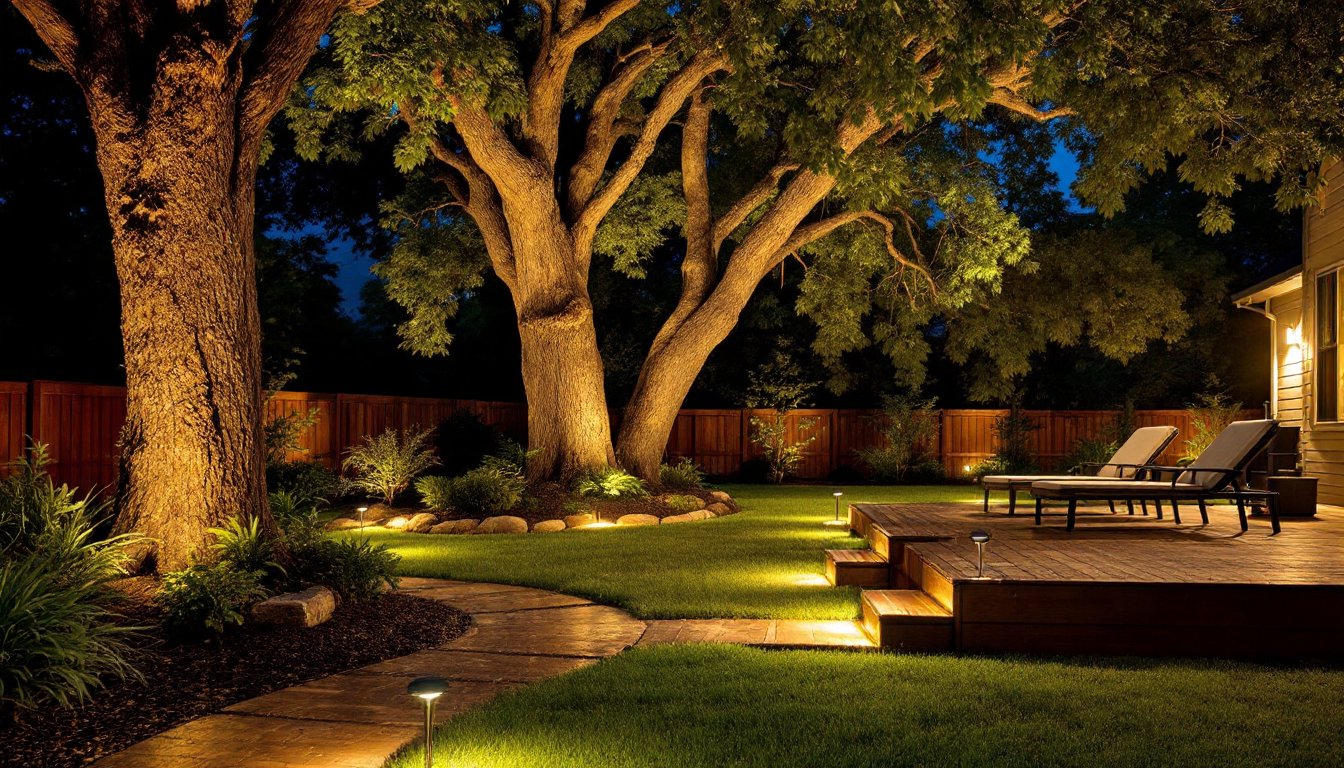
Pathway and accent lighting is the most common use. Low-voltage fixtures cast a soft pool of light along walkways, driveway borders, and garden beds without the harsh glare of high-wattage floodlights. Spacing fixtures 4–6 feet apart along a path typically creates even illumination.
Uplighting and grazing, where light grazes the face of a tree, fence, or architectural feature, brings drama to evening landscaping. A single well-placed uplight on a mature oak or specimen shrub creates a natural focal point visible from a patio or driveway. Moonlighting, where fixtures are mounted high in trees to cast dappled shadows below, mimics natural moonlight and is popular for ambient deck or seating areas.
Deck and patio lighting benefits from low-voltage rail systems or recessed step lights that mount flush with deck boards or risers. These keep sight lines clean and reduce trip hazards compared to traditional deck floods. Underwater pond and water feature lighting uses sealed, low-voltage fixtures rated for submersion, creating reflective shimmer without exposing the water feature to standard electrical risk.
Security lighting around gates, entry points, or dark corners often pairs low-voltage accent lights with motion sensors, though standard high-wattage security floods remain more common for maximum intensity coverage.
Choosing the Right Volt System for Your Landscape
Start with voltage selection: 12-volt systems are more common and have broader fixture availability, while 24-volt systems allow longer cable runs, up to 100+ feet, before voltage drop becomes noticeable. For most residential landscapes under 50 feet from transformer to farthest fixture, 12-volt works fine.
Next, calculate total wattage. List each planned fixture and its wattage, then add them up. A typical kit includes a transformer rated for 60–300 watts. Oversizing the transformer by 20–30% is smart: it runs cooler, extends component life, and leaves room for future additions. Check the transformer’s specifications for voltage output (some allow 12V and 24V settings) and load capacity.
Cable gauge matters for voltage drop. At 12 volts, using undersized wire, say 14 AWG instead of 12 AWG, over 50+ feet causes noticeable dimming at distant fixtures. Chart the cable route before purchasing to confirm adequate wire gauge and total length. Most kits include premium-grade cable: avoid cheap alternatives that corrode underground.
Choose LED fixtures unless budget is severely constrained. Halogen alternatives are cheaper upfront but fail faster and consume more power. Verify fixture beam angle and color temperature (warm white around 2700K looks inviting: cool white 5000K+ is harsher for residential spaces). Finally, consider automation: a photocell timer (often built-in) is essential: smart-home integration is nice-to-have if the budget allows. Test the system in daylight before burying cable or finalizing placements, it’s easier to adjust now than dig later.
Conclusion
Volt outdoor lighting offers a practical, safe, and energy-efficient way to enhance landscape aesthetics and function without contractor overhead or complex permits. For most DIYers, a quality 12-volt LED kit delivers years of reliable performance at a reasonable cost. The key is matching system capacity to the scope of the project, using proper cable gauge, and taking time on layout and installation so the landscape lights work as intended season after season.