Bathroom lighting does more than help you see your reflection, it sets the mood, supports functionality, and can make a small space feel larger or a tired bathroom feel brand new. Yet many homeowners settle for a single overhead fixture and wonder why their bathroom feels either too harsh or too dim. The best bathroom lighting combines three distinct layers: ambient (general), task (focused), and accent lighting, strategically placed to serve different needs throughout the day. This guide walks through how to layer bathroom lighting effectively, avoiding common pitfalls like shadows over the vanity or glare that turns your morning routine into a squint fest. Whether you’re refreshing a rental or planning a full bathroom remodel, understanding lighting fundamentals will help you make choices that actually work in daily life.
Table of Contents
ToggleKey Takeaways
- The best lighting for bathroom combines three layers—ambient, task, and accent lighting—to eliminate shadows, reduce glare, and support both functionality and mood.
- Install task lighting with vertical sconces 36–40 inches apart at eye level (60 inches from the floor) to prevent shadows during grooming and makeup application.
- Use 4000K color temperature for vanity lighting to reveal true skin tones and 2700K–3000K for ambient areas to create a warm, inviting atmosphere.
- Recessed ceiling lights for ambient lighting should be spaced 4–6 feet apart and positioned forward of the mirror, avoiding overhead placement that casts facial shadows.
- Install LED-compatible dimmer switches to adjust brightness for different tasks and times of day—proper bathroom lighting requires flexibility, not just high lumen output.
- Aim for 2,000–3,200 lumens from ambient lighting in a standard bathroom, 1,500–2,000 lumens concentrated at the vanity, and 5–10% additional brightness for accent layers.
Why Proper Bathroom Lighting Matters
Bad bathroom lighting ruins grooming tasks and wastes money. Shadows cast by a single ceiling fixture make shaving, makeup application, and skincare routines frustrating. Dark corners collect moisture and mold goes unnoticed longer. Conversely, overlighting creates glare that bounces off tile and mirrors, straining eyes during early mornings or late nights.
Proper lighting also affects perceived space and mood. A well-lit bathroom with balanced brightness feels clean, spacious, and welcoming. It reduces accidents, good visibility near tubs, showers, and stairs prevents slips. From a practical standpoint, correct lighting placement and intensity reduce eye strain, support safety, and create an environment where people actually want to spend time. Over the long term, investing in quality fixtures and thoughtful placement pays off in both comfort and home value.
Understanding Bathroom Lighting Layers
Professional designers and contractors layer lighting into three categories, each serving a distinct purpose. Combining all three prevents over-reliance on any single fixture and gives flexibility for different times of day.
Ambient Lighting
Ambient (or general) lighting illuminates the entire bathroom evenly. A central ceiling fixture, recessed lights spaced across the ceiling, or a soffit are typical choices. This layer shouldn’t be the only light source, it provides baseline visibility but rarely delivers enough task light at the vanity. Aim for 50–80 lumens per square foot for ambient bathroom lighting. A bathroom roughly 5′ × 8′ (40 sq. ft.) might need 2,000–3,200 lumens total from ambient sources. Recessed 4-inch or 6-inch fixtures spaced 4–6 feet apart work well in medium ceilings: spacing them too far creates dark patches between lights.
Task Lighting
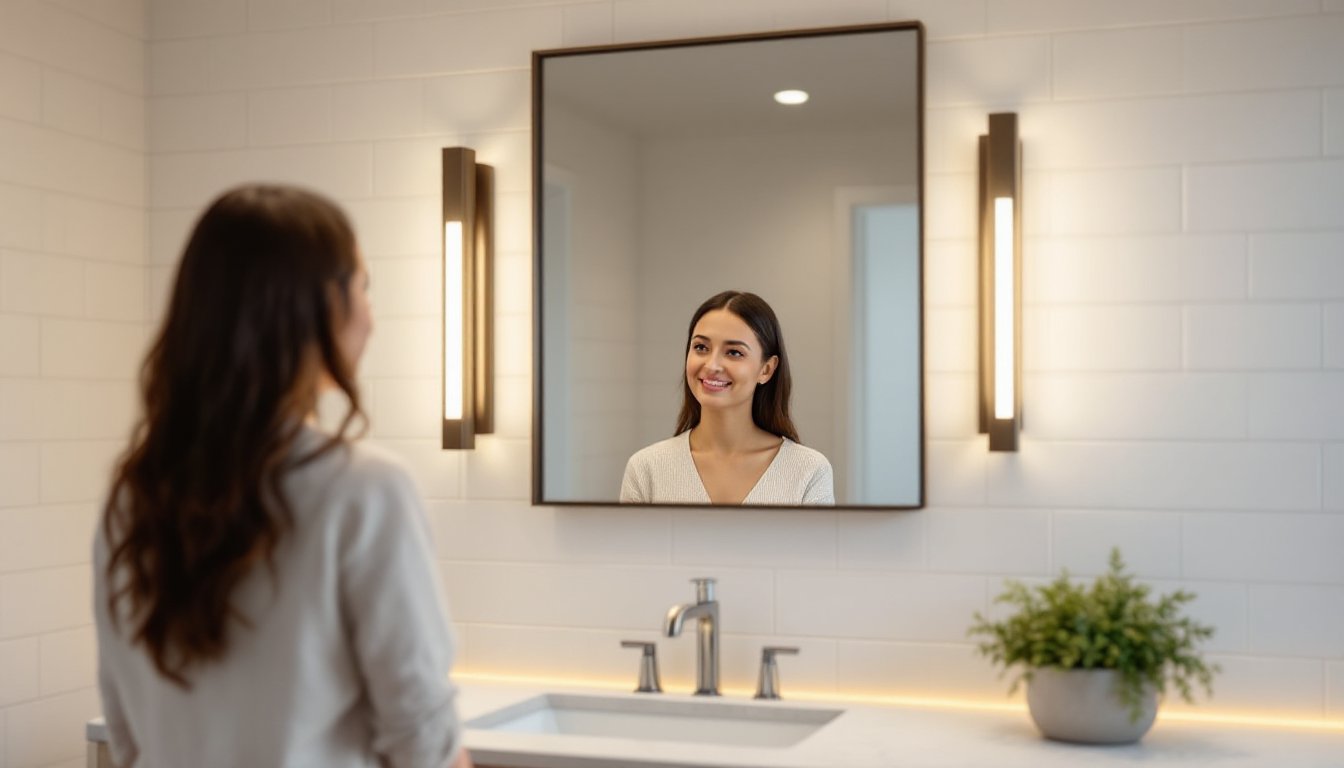
Task lighting focuses on work areas, primarily the vanity, where grooming happens. Sconces flanking the mirror or a fixture above it prevents shadows on your face. This is where people notice poor lighting most. Task lights at the vanity should deliver 1,500–2,000 lumens, concentrated at face level. Vertical sconces placed 36–40 inches apart (measured center-to-center) on either side of the mirror eliminate shadows that a single overhead fixture can’t avoid. If space is tight, a single linear fixture above the mirror works, but side sconces are superior for makeup and shaving. Bathroom lighting guides often recommend 3,000–4,000K color temperature for task areas, warm enough to feel inviting but cool enough to show true skin tone.
Accent Lighting
Accent lighting highlights architectural features, adds warmth, and improves perceived depth. Under-cabinet lighting, LED strips behind floating shelves, or a lit mirror frame fall into this category. Accent lighting uses 5–10% of total bathroom brightness and creates visual interest without overwhelming. It’s the “nice to have” layer, useful but not mandatory, especially in small bathrooms or quick renovation budgets.
Best Light Placement and Fixture Types
Placement beats aesthetics. A beautiful $300 fixture in the wrong spot creates shadows: a modest, well-placed fixture works better than a statement piece installed poorly.
Vanity sconces are the gold standard for bathroom task lighting. Install them 36–40 inches apart (center-to-center), with the center of each fixture at approximately 60 inches from the floor, roughly eye level when standing at the sink. This height avoids casting shadows downward while providing even face lighting. Sconces should extend 4–6 inches from the wall to wrap light around the face without glare.
Mirror-mounted or above-mirror fixtures work in smaller spaces. A linear fixture (bar light) 24–30 inches wide centered above a standard vanity mirror provides decent task lighting. This arrangement is simpler to install than sconces but doesn’t eliminate shadows as effectively.
Recessed ceiling lights handle ambient lighting. In a standard 8-foot ceiling, space 4-inch recessed trims 4–6 feet apart. Avoid placing them directly above or behind the vanity: they’ll cast shadows on the face even if the rest of the bathroom is bright. Place them slightly forward of the mirror or in the toilet and tub areas for even coverage without harsh facial shadows.
Shower and tub lighting needs a fixture rated for damp or wet locations (look for IP54 or IP65 ratings, IP55 minimum). Install fixtures on the ceiling or high on walls, never directly in the shower path. A recessed fixture with a waterproof trim works: surface-mounted models are also available and easier to retrofit.
Dimmer switches are not optional, they’re essential. A dimmer lets occupants adjust brightness for different tasks and times of day. Install LED-compatible dimmers: not all dimmers work well with all LED bulbs. Verify compatibility at purchase.
Choosing the Right Color Temperature and Brightness
Color temperature and lumen output define how welcoming and functional a bathroom feels.
Color temperature is measured in Kelvin (K). Lower numbers (2700K) are warm and yellowish: higher numbers (4000K–5000K) are cool and bluish.
- 2700K: Warm white, flattering for skin tones and relaxing. Good for ambient lighting or spa-like atmospheres.
- 3000K–3500K: Neutral warm. A popular middle ground for bathrooms, inviting without losing clarity.
- 4000K: Bright white, often called “cool white.” Excellent for task lighting and vanity mirrors because it shows true colors and skin tones without distortion.
- 5000K+: Daylight or cool. Best for detailed work but can feel clinical in a bathroom.
For best bathroom lighting outcomes, use 4000K for task areas (vanity sconces and mirror lighting) and 2700K–3000K for ambient and accent lighting. This combination feels balanced, warm and inviting overall, with bright, shadow-free task light where it matters.
Brightness is measured in lumens. More lumens = more light. A common mistake is installing high-lumen fixtures without dimmers, creating a harsh, exhausting environment. Use this rough guide:
- Ambient: 50–80 lumens per square foot
- Task (vanity): 1,500–2,000 lumens, concentrated
- Accent: 100–300 lumens per fixture (very minimal)
For a typical 5′ × 8′ bathroom, aim for 2,000–3,200 lumens from ambient sources, 1,500–2,000 lumens from task lighting, and optional 200–400 lumens from accent lighting if included. Install dimmers on ambient fixtures so occupants can reduce brightness during evening routines.