Kitchen lighting is one of the most underestimated elements of a successful remodel. Most homeowners focus on cabinets and counters, then slap a single overhead fixture in the middle of the room and call it done. That approach leaves you squinting over cutting boards, casting shadows on your workspace, and wondering why cooking feels so exhausting. The best lighting for kitchen spaces isn’t about buying the brightest bulb, it’s about layering different light sources strategically to serve your workflow, highlight your design, and make the space feel inviting. Whether you’re overhauling everything or tweaking what’s there, this guide walks you through choosing fixtures that actually work for how you cook and live.
Table of Contents
ToggleKey Takeaways
- The best lighting for kitchen design uses a three-layer system—ambient, task, and accent lighting—to create depth, functionality, and visual appeal instead of relying on a single overhead fixture.
- Task lighting over counters, sinks, and stoves with LED strips or pendant lights eliminates shadows and prevents prep work strain, making cooking safer and more efficient.
- Aim for 4000K (cool white) ambient light for true color rendering and clear visibility, paired with 2700K–3000K accent lighting for warmth and evening ambiance.
- LED bulbs are the optimal choice for kitchen lighting, using 75–80% less energy than incandescent, lasting 15,000–25,000 hours, and supporting dimmable fixtures for mood control.
- Under-cabinet LED strips and multiple recessed cans spaced 4–6 feet apart deliver even illumination without hotspots, while proper fixture placement prevents heat and steam damage around stoves.
Why Kitchen Lighting Matters More Than You Think
Your kitchen isn’t just where you grab coffee in the morning, it’s where you prepare meals, read recipes, pay bills, and often gather as a family. Poor lighting turns these tasks into a strain. Cooking with inadequate task lighting leads to uneven prep, burns, and cut mistakes. Harsh overhead light bounces off white counters and creates that clinical, unwelcoming vibe that makes spending time in the space feel like work. Meanwhile, dim ambient lighting signals your brain that the kitchen is a “utility room,” not a place worth lingering.
Good kitchen lighting does several things at once. It eliminates shadows and glare where you’re working. It flatters the space and makes it feel larger and more welcoming. It supports different moods, bright and energetic in the morning, softer in the evening. It also needs to work with your home’s electrical infrastructure and, in some cases, comply with local building codes. Kitchen lighting isn’t a luxury detail: it’s the backbone of a functional, livable space.
The Three-Layer Lighting System Every Kitchen Needs
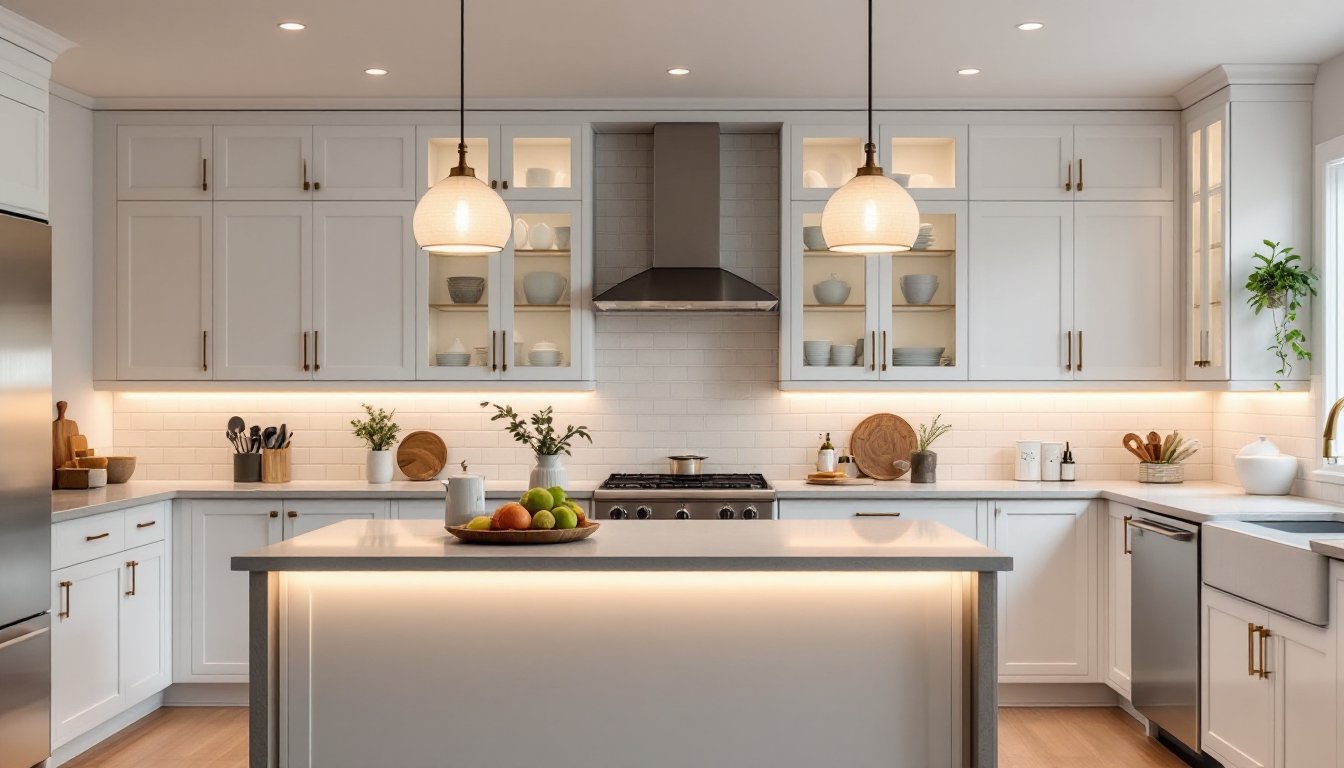
Professional designers use a three-layer approach: ambient, task, and accent lighting. Each serves a different purpose, and together they create depth, function, and flexibility. Think of it like cooking itself, you need a solid base (ambient), the tools to get the job done (task), and a little finesse to make it shine (accent).
Ambient Lighting: Your Foundation
Ambient lighting is your general, overall illumination. This is the light that fills the entire room without creating hotspots or harsh shadows. Most kitchens start with a ceiling-mounted fixture, often a recessed can light or a flush-mount, but a single central fixture rarely distributes light evenly across a galley or large kitchen.
For even ambient coverage, aim for 1 watt per square foot as a rough baseline. A 120-square-foot kitchen would need roughly 120 watts of ambient light total, though this varies with ceiling height, wall color, and how much task lighting you add. Multiple recessed cans spaced 4 to 6 feet apart (center to center) deliver more uniform light than a single fixture. If you don’t want to rewire, consider a semi-flush or low-profile dome light paired with under-cabinet task lighting to boost overall brightness without the overhead “cave” feeling.
Color temperature matters here too. Most kitchens look best with 4000K (cool white) ambient light, it’s neutral, energizing, and mimics midday daylight without the blue cast of 5000K or the yellow warmth of 2700K.
Task Lighting: Where Functionality Shines
Task lighting puts bright, focused light exactly where you’re working. This is where your kitchen actually becomes functional. The best places for task lighting are over the stove, sink, and primary prep counter.
Under-cabinet lighting is the most practical choice. LED strip lights (either stick-on or hardwired) mount to the underside of cabinets and shine down onto the counter, eliminating shadows cast by your own body. Aim for at least 250-300 lumens per linear foot for true prep work. If you’re retrofitting without running new electrical, self-adhesive LED strips plug into an outlet (usually under the sink) and deliver solid performance at a fraction of the cost of hardwired fixtures.
Pendant lights hung 30 to 36 inches above the counter over a prep island work well too. They provide downward-focused light and add visual interest. Choose opaque or translucent shades to avoid glare: avoid fully open bowls that shine light upward into eyes.
Recessed cans over the stove (properly spaced) help you see what’s cooking. Because heat and steam rise from a stove, ensure fixtures are rated for that environment and use damp-rated fixtures as a minimum.
Task lighting should be 3000K to 4000K, bright enough to see clearly without straining, but not so blue it looks sterile.
Accent Lighting: Creating Atmosphere
Accent lighting highlights architectural features, artwork, or open shelving and sets the mood. It’s not essential for function, but it transforms a kitchen from “workspace” to “room you actually want to be in.”
LED tape hidden above crown molding or inside open shelving casts soft indirect light. Puck lights (small, round fixtures) mounted inside glass-front cabinets draw attention to dishware or collections. Wall sconces flanking a mirror or on either side of a doorway add layered warmth.
Accent lighting typically runs 2700K to 3000K, warmer and dimmer than task light, almost never brighter than ambient. Keep it at maybe 25–30% of your total light output. The goal is subtle enhancement, not a second task light masquerading as ambiance.
Best Fixture Types for Kitchen Spaces
Choosing the right fixture type depends on your kitchen layout, ceiling height, and remodeling scope. Here’s what works best in real kitchens.
Recessed Can Lights (6-inch or 5-inch): Standard, flexible, and clean-looking. They disappear into the ceiling and work with almost any décor. Downside: they create hotspots if spaced too far apart, and installing them requires cutting holes and running electrical (unless retrofit kits are used). Dimmable LED bulbs rated for enclosed fixtures prevent heat buildup in regular cans.
Semi-Flush and Flush-Mount Fixtures: Dome or drum-shaped fixtures mounted close to the ceiling. These work well in smaller kitchens or 8-foot ceilings where you want a single statement piece. Look for frosted diffusers to soften light and minimize glare. Swap out the bulb for a dimmable LED to control brightness.
Under-Cabinet LED Strips: The workhorse of kitchen task lighting. Hardwired models run cleaner but require new wiring: plug-in strips are easier retrofits. Choose warm white 3000K under cabinets to match ambient, or neutral 4000K if you want brighter task light. Avoid cheap strips with visible diodes (those look cheap and flicker).
Pendant Lights: Hung 12–18 inches above an island or peninsula, they provide task light and visual impact. Materials range from metal and glass to wood and fabric. Ensure the shade directs light downward and prevents glare upward. Dimmable fixtures let you adjust from bright work mode to dinner ambiance.
Track Lighting: Adjustable heads on a mounted rail. Useful for highlighting open shelving or directing light to dark corners. Can feel dated if overused, but works in modern, industrial, or transitional kitchens.
Sconces and Wall Lights: Often overlooked in kitchens, sconces add depth and warmth, especially paired with other layers. Use them symmetrically flanking a doorway or sink window for balance.
Color Temperature and Energy Efficiency: What Really Works
Color temperature, measured in Kelvin (K), defines whether light looks warm (yellowish) or cool (bluish). In a kitchen, it shapes both function and mood.
2700K (Warm White): Resembles incandescent bulbs. Cozy and flattering, but not ideal for detailed prep work. Good for accent lighting or evening ambiance.
3000K (Soft White): A middle ground. Warm enough to feel inviting, bright enough for light cooking tasks. Popular choice for general kitchen use.
4000K (Cool White/Neutral White): Closest to midday daylight. Ideal for task lighting and true color rendering (you see food and ingredients as they actually are). Can feel clinical if it’s the only light source.
5000K+ (Daylight): Very cool and energizing. Useful for studio tasks or if your kitchen lacks windows, but tiring as ambient light alone.
The best kitchen mixes 4000K for task and ambient, with 2700K–3000K accent light for evening softness. Dimmable fixtures let you dial in the mood: even bright 4000K ambient light softens when dimmed to 40–50%.
LED bulbs (especially A19 or PAR16 equivalents) are now the standard for kitchens. They use 75–80% less energy than incandescent, last 15,000–25,000 hours, and run cool enough to mount in any fixture. Choose dimmable LEDs if your fixture has a dimmer switch (not all LEDs dim smoothly with older switches). Look for CRI (Color Rendering Index) above 90 so colors, especially skin tones and food, look true.
Halogen and older incandescent bulbs waste energy as heat and don’t last long. Fluorescent (CFL) bulbs are energy-efficient but take time to warm up, emit hum, and don’t always pair well with dimmers. For a kitchen, LED is the clear winner: efficiency, longevity, and light quality all in one.