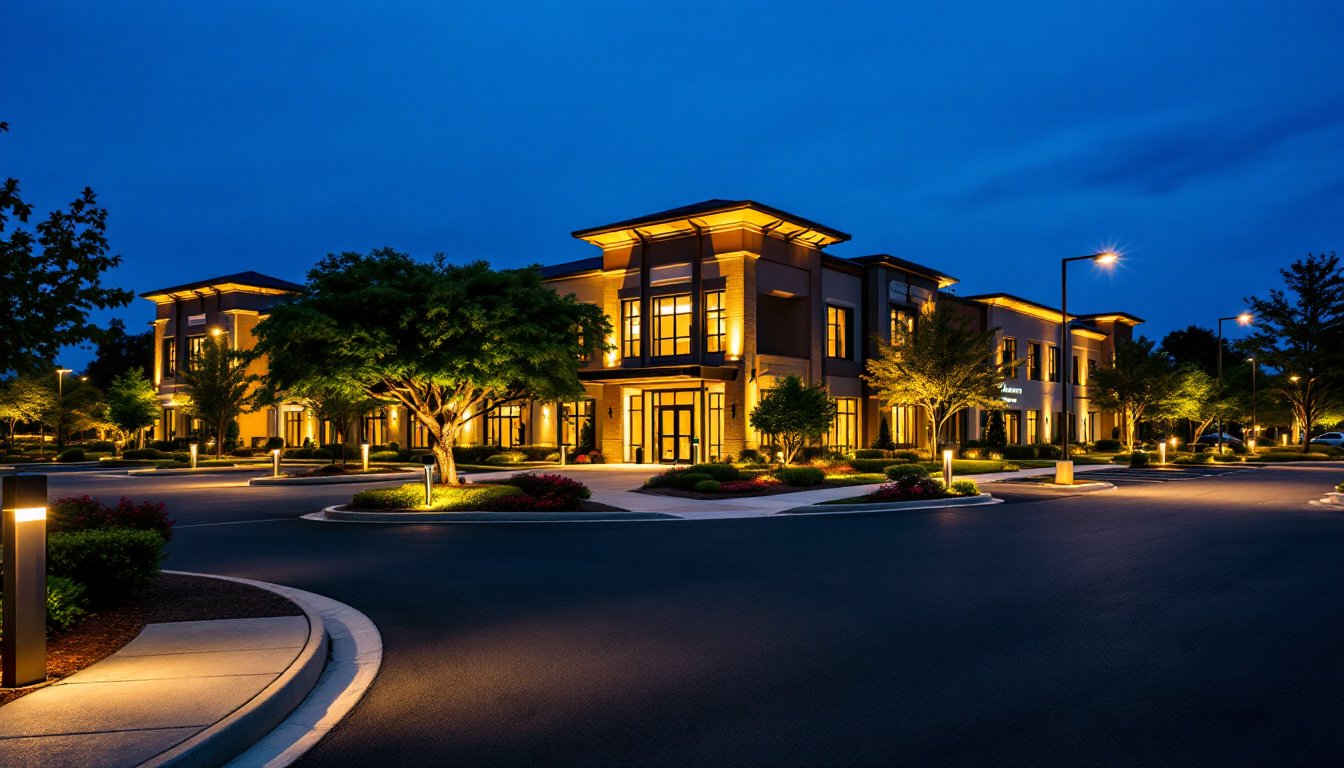
Commercial outdoor landscape lighting transforms properties after dark, boosting curb appeal while strengthening security and safety. Whether managing a retail storefront, office park, or hospitality venue, the right lighting strategy creates an inviting atmosphere and deters unwanted activity. Today’s commercial outdoor landscape lighting systems go beyond basic floodlights, they combine energy-efficient LED technology, smart controls, and thoughtful design to enhance property value and operational efficiency. This guide covers everything property managers and facility directors need to know about selecting, installing, and maintaining outdoor lighting that delivers both aesthetic impact and measurable returns.
Table of Contents
ToggleKey Takeaways
- Commercial outdoor landscape lighting enhances curb appeal, security, and property value while extending usable hours for retail, office, and hospitality properties.
- LED fixtures consume 70–80% less energy than halogen alternatives and last 3–5 times longer, delivering payback periods of 2–3 years through reduced energy and maintenance costs.
- Proper design requires mapping high-traffic zones for uniform illumination (parking lots need 1.5–3 foot-candles per IESNA standards) and accent areas for mood lighting to balance safety with aesthetics.
- Low-voltage pathway and accent systems are DIY-friendly, but line-voltage floodlights and hardwired installations require a licensed electrician and compliance with National Electrical Code Article 225.
- Smart controls like motion sensors, daylight sensors, and programmable schedules maximize savings by ensuring commercial outdoor landscape lighting runs only when needed.
- Quarterly inspections, annual lens cleaning, and professional evaluation every 2–3 years keep systems performing optimally with a reasonable $1,000–$2,000 annual maintenance budget for mid-sized commercial properties.
Why Commercial Landscape Lighting Matters
Proper commercial outdoor landscape lighting serves dual purposes: it extends your property’s usable hours and protects your investment. Well-lit parking lots, entryways, and building facades create a professional first impression while actively reducing liability. Dark or poorly lit areas invite security risks, trip hazards, and customer hesitation, especially critical for hospitality, retail, and office properties open during evening hours.
Beyond safety, landscape lighting enhances property valuation. Studies consistently show that strategic outdoor lighting increases perceived property value and rental appeal. It also improves customer experience: people are more likely to linger at a well-lit outdoor dining area or feel confident walking through a lit parking structure. For commercial properties, this translates to increased foot traffic, longer visits, and stronger tenant retention.
Types of Outdoor Lighting Systems for Commercial Properties
Pathway and Accent Lighting
Pathway lights guide visitors safely while defining landscape features. These are typically low-voltage LED bollard lights (6-12 inches tall) or in-ground well lights placed along walkways, around planters, or along building perimeters. They operate on 12-volt systems, requiring a transformer to step down standard 120-volt power. Because of the low voltage, installation is simpler and safer than line-voltage work, no trenching to code depth is necessary, and accidental contact poses minimal shock risk.
Accent lighting highlights landscape features: specimen trees, architectural details, water features, or signage. Uplighting a mature oak creates visual drama: spotlighting a building corner draws the eye to design elements. Most accent fixtures are low-voltage or LED line-voltage spotlights rated for wet locations (rated IP65 or higher for splash resistance).
Floodlights and Uplighting
Commercial properties typically rely on line-voltage floodlights (120 or 277 volts) for larger areas like parking lots, loading docks, and building facades. These fixtures deliver higher brightness (measured in lumens) and cover greater distances than low-voltage alternatives. A typical 400-watt halogen or LED flood fixture illuminates a 4,000–6,000 square-foot area with suitable brightness.
Uplighting creates depth and visual interest by casting light upward along building surfaces or landscape elements. When paired with directional controls or shields, uplighting minimizes glare and light trespass, important for neighboring properties and dark-sky compliance in regulated areas. LED uplights are preferable for commercial use: they generate less heat (reducing cooling loads) and last 25,000–50,000 hours versus 2,000–5,000 for halogen equivalents.
Key Design Considerations for Maximum Impact
Effective commercial outdoor landscape lighting balances illumination levels with energy consumption and aesthetics. Start by mapping your site: identify high-traffic areas needing bright, uniform light (parking lots, entryways) versus accent zones (landscaping, building facades) that benefit from mood lighting.
Uniform illuminance matters for safety and perceived security. Parking areas should meet IESNA (Illuminating Engineering Society) standards: typically 1-2 foot-candles for residential-adjacent parking, 1.5-3 for standard commercial lots. Avoid over-lighting, which wastes energy and creates glare. Entryway zones demand 2-5 foot-candles to ensure visitors can see faces and footing clearly.
Fixture mounting height and angle affect coverage and glare. A 20-foot pole with a downward-aiming floodlight covers a wider, more even area than a 10-foot mounting point with the same fixture. But, taller poles increase installation cost and wind load concerns. Consider a mix: wall-mounted uplights on the building itself, medium-height fixtures for mid-ground landscaping, and pathway lights at grade level.
Color temperature impacts ambiance. 3000K (warm white) LED fixtures feel inviting for hospitality venues, while 5000K (cool white) suits parking and security-focused areas. Consistency matters, mixing color temperatures reads as careless, not creative. Shield or direct fixtures to prevent light spill onto neighboring properties: this protects your reputation and respects community dark-sky efforts.
Energy-Efficient LED Solutions and Cost Savings
Switching from halogen or incandescent to LED fixtures delivers immediate operational savings. LEDs consume 70–80% less energy than traditional bulbs while lasting 3–5 times longer. For a commercial property running 12-hour nightly lighting cycles, the cost difference becomes substantial within a year or two.
But, not all LED fixtures are equal. Cheap, poorly designed LEDs sometimes produce harsh color rendering or flicker under dimmer controls. Specify commercial-grade LED fixtures rated for wet locations with minimum 90+ Color Rendering Index (CRI) to ensure colors and architectural details look true to life. Expect to pay $150–$400 per fixture for quality pathway lights and $300–$800 for LED flood or spotlights.
Calculate long-term ROI: if replacing 20 halogen 400-watt fixtures operating 12 hours nightly at $0.14 per kWh, the annual energy cost is roughly $40,000. LED equivalents (typically 100-150 watts) cut that to $10,000–$12,000 annually, a $28,000+ yearly savings. Factor in reduced maintenance labor (LEDs rarely burn out), and payback periods often fall within 2–3 years.
Integrate smart controls and timers to stretch savings further. Motion sensors in low-traffic zones, daylight sensors that dim during twilight, and programmable schedules ensure lights run only when needed. Many commercial LED systems now offer WiFi or cellular controls, allowing property managers to adjust brightness and schedules remotely, valuable for responding to seasonal changes or special events.
Installation, Maintenance, and Professional Support
Low-voltage landscape lighting (12-volt pathway and accent systems) is often DIY-friendly: bury cable in shallow trenches, connect fixtures to a transformer, and run it on a timer. For line-voltage work (120 or 277 volts), particularly parking lot floodlights and hardwired building fixtures, hire a licensed electrician. Line-voltage circuits require proper bonding, grounding, conduit, and permits per National Electrical Code (NEC) Article 225 for outdoor installations. Risk of shock, fire, or code violation isn’t worth cutting corners.
Installation considerations include:
- Cable placement: Low-voltage cable can run within a few inches of the surface: line-voltage must be in conduit and buried 18–24 inches deep in most jurisdictions.
- Transformer location: Keep 12-volt transformers close to fixtures (cable loss increases over distance) and protected from weather and foot traffic.
- Fixture positioning: Ensure uplights and floodlights are angled to prevent glare into windows or neighbor yards: many codes restrict upward lighting.
- Permits: Many jurisdictions require electrical permits for outdoor work, check local building department requirements before starting.
Maintenance is minimal for LED systems but not zero. Inspect fixtures quarterly for damage, sediment accumulation, or loose connections. Clean lamp lenses and reflectors annually (dust reduces output by 10–20%). Replace batteries in solar or wireless controls annually, and test all switches and timers seasonally. For hardwired systems, schedule professional inspection every 2–3 years, especially in coastal or freeze-thaw climates where corrosion accelerates.
When problems arise, dimming bulbs, tripped circuits, or glitchy controls, professional electricians or specialized landscape lighting contractors can diagnose and repair quickly. Factor maintenance and occasional repairs into your annual budget: a $1,000–$2,000 yearly allowance for a mid-sized commercial property’s lighting system is reasonable.
Getting the Most From Your Commercial Landscape Lighting Investment
Commercial outdoor landscape lighting isn’t a set-and-forget purchase. Thoughtful design, quality fixtures, and proper maintenance compound the benefits: enhanced property appeal, improved safety, operational savings, and stronger tenant or customer satisfaction. Start with a clear plan of what you want to illuminate and why, invest in energy-efficient LED systems from reputable manufacturers, and don’t skip professional installation for hardwired circuits. Regular inspections and seasonal adjustments keep your lighting performing its best, turning your property into an asset that works around the clock.